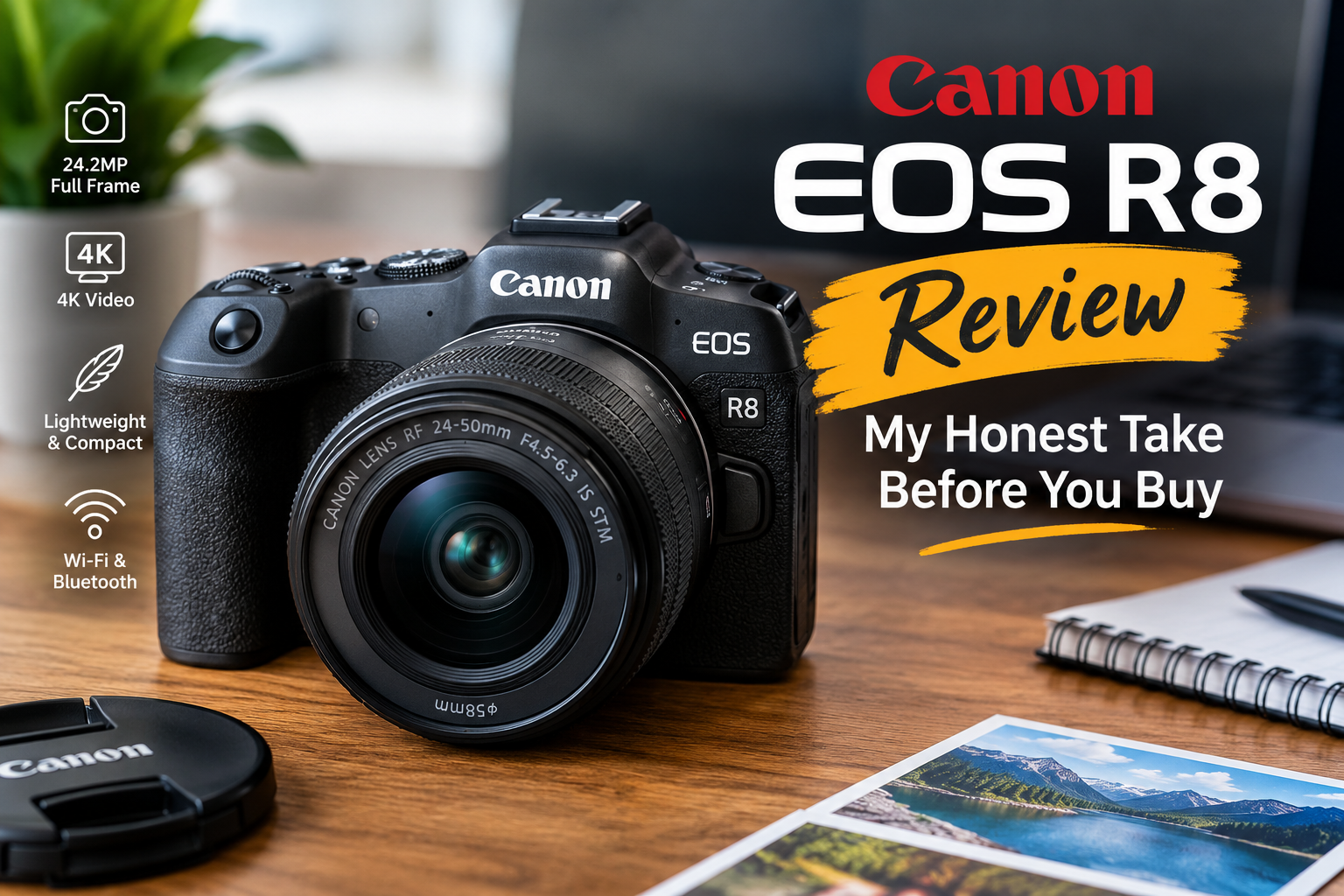

Okay, let’s talk about the Canon EOS R8. If you’ve landed here, chances are you’ve already watched a couple of YouTube reviews, read a spec sheet that made zero sense, and now you just want someone to tell you straight — is this thing actually good, or is it just good marketing?
Here’s the short answer: it’s genuinely good. But like anything, it’s not perfect for everyone. Let’s get into why.
So What Is This Camera, Really?
The Canon EOS R8 is a mirrorless, full-frame camera. I know “full-frame” gets thrown around a lot like it’s some magic word, so here’s the plain version — it just means the sensor inside is bigger than what you’d find in a cheaper camera or your phone. Bigger sensor, generally, means better photos. Especially in tricky lighting, like a dark cafe or a golden-hour shoot where everything looks moody and gorgeous if the camera can actually handle it.
What’s interesting about the R8 is that Canon basically took the guts of a more expensive camera — the EOS R6 Mark II — and put it in a smaller, lighter, cheaper shell. That’s not a bad deal at all.
Why People Keep Recommending This Camera
It Punches Above Its Price Tag
Look, cameras used to be one of those “you get what you pay for, no shortcuts” categories. The R8 kind of breaks that rule. You’re getting the same sensor as a pricier camera, which honestly feels like a bit of a loophole in Canon’s favor — but hey, we’re not complaining.
The Autofocus Is Almost Annoyingly Good
I say “annoyingly” because once you use a camera that tracks eyes, faces, pets, even cars, without you doing anything — it’s hard to go back. You point, it finds the subject, it sticks to it. A toddler sprinting across a room, a dog that refuses to sit still for two seconds, someone walking toward you at a wedding — the camera just keeps up. For beginners especially, this takes a lot of pressure off.
Video That Doesn’t Look Like an Afterthought
Some cameras are clearly built for photos first, and video feels bolted on. Not really the case here. The R8 shoots proper 4K, and it looks sharp and clean without needing a ton of editing to fix it. If you’re the type who wants to start a YouTube channel, film product demos, or just record family stuff that doesn’t look grainy, this camera handles it well. The flip screen helps too, especially if you’re filming yourself.
You’ll Actually Want to Carry It Around
This might sound small, but it matters more than you’d think. A lot of full-frame cameras are heavy — the kind where your shoulder starts complaining after an hour. The R8 is noticeably lighter. That means you’re more likely to actually bring it with you, instead of leaving it at home because “it’s too much hassle.”
Now, Let’s Talk About the Not-So-Great Parts
Every camera has trade-offs, and I’d be lying if I said this one didn’t.
No in-body stabilization. This is probably the biggest one people bring up. The camera itself doesn’t stabilize shaky hands — you’re relying on the lens for that. Most modern Canon lenses do have stabilization built in, so it’s not a disaster, but it’s worth knowing upfront.
Only one card slot. If you’re the kind of person who wants a backup copy of every photo saved automatically (which, fair, especially for big events), this might bug you. For casual shooting, though, it’s honestly a non-issue.
Battery life is average, not amazing. Smaller body, smaller battery — that’s just how it goes. If you’re planning a long shooting day, especially with video, grab a spare battery. You’ll thank yourself later.
Fewer physical dials. If you’re coming from a more advanced camera with buttons for everything, this might feel a little stripped down. For beginners, though, it actually makes things less overwhelming.
Who Should Actually Buy This Camera?
Not gonna pretend this camera is for literally everyone, because no camera is. But it’s a great fit if you’re:
- Moving up from phone photography and want a real upgrade
- New to full-frame cameras and don’t want to spend a fortune to try one
- A content creator or small business owner who needs solid video
- Someone who travels a lot and doesn’t want a heavy bag
- Just looking for something that works well without a huge learning curve
If you’re shooting weddings professionally every weekend and need dual card slots as a safety net, you might eventually want to look at something a step up. But for most people reading this? The R8 is more than enough.
Is It Actually Beginner-Friendly, Though?
Yes — and I mean that genuinely, not in the watered-down way brands usually say it. The menus aren’t confusing, the autofocus does most of the hard work, and the lighter body means you’re not exhausted just from holding it. A lot of people assume full-frame cameras are intimidating. This one quietly proves that assumption wrong.
My Final Take
At the end of the day, the Canon EOS R8 does something that’s actually kind of rare — it feels like a proper, capable camera without demanding a proper, painful budget. Sharp photos, dependable autofocus, solid video, and a body you won’t dread carrying around all day.
Sure, it skips a couple of extras that pros might want — in-body stabilization, dual card slots. But for hobbyists, students, and creators just getting serious about photography, those are easy trade-offs to live with.
If you want a camera that’ll grow with you as you improve, without wrecking your budget on day one, the Canon EOS R8 is absolutely worth putting on your shortlist.
Frequently Asked Questions
Yes, honestly one of the more approachable full-frame cameras out there right now.
Yes — sharp 4K footage that’s more than good enough for YouTube, Instagram, or personal projects.
Not in the body itself, but a lot of compatible lenses have their own stabilization built in.
Definitely — its lighter weight makes a real difference after a full day of walking around with it.
If you want strong full-frame performance without overspending right away, the R8 is a smart, practical starting point.