
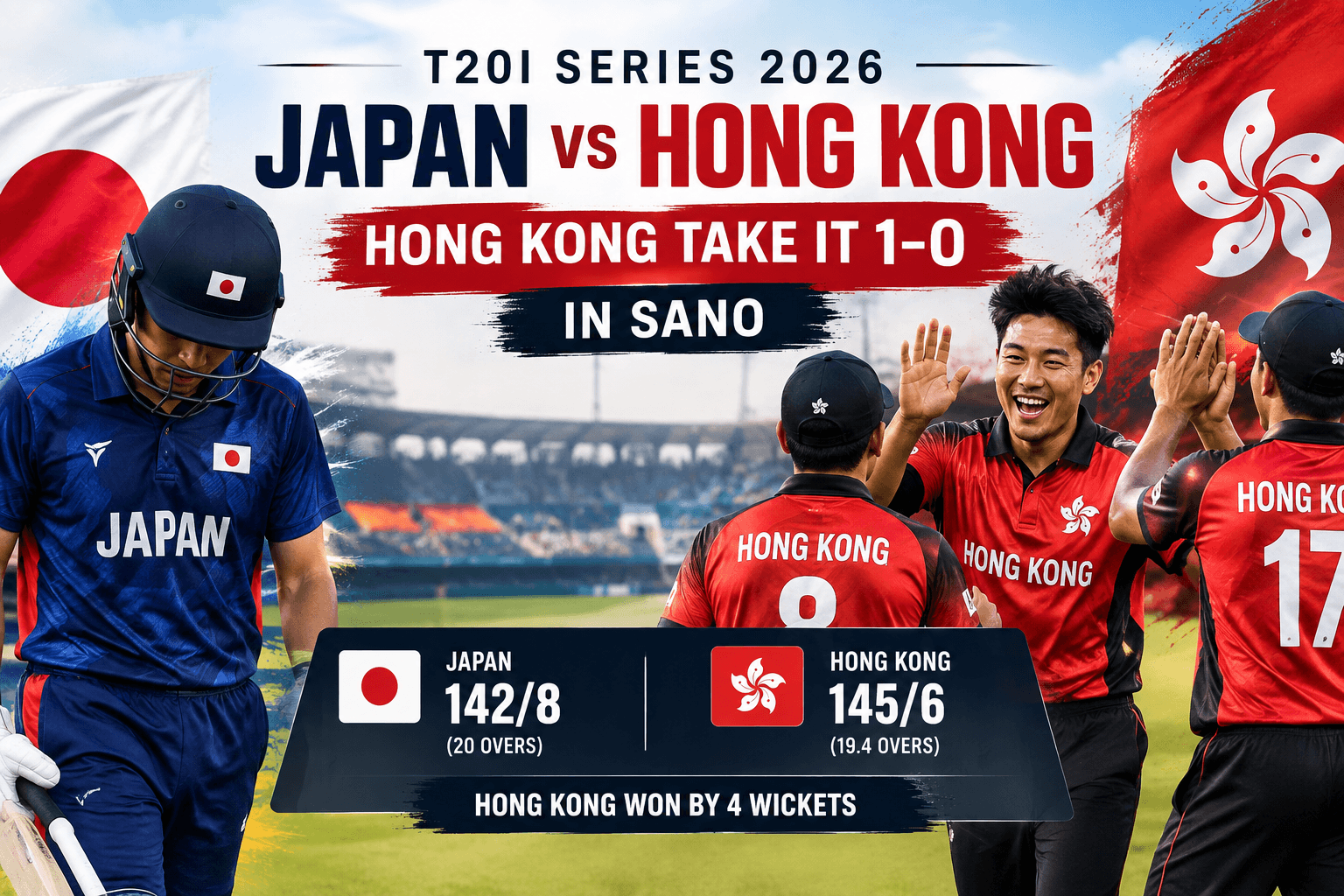

Some series are decided over five tense matches. This one was decided by a single game and a lot of waiting around.
The Japan vs Hong Kong T20I series 2026 finished 1–0 in Hong Kong’s favour. They won the first match by four wickets, and the second never got going. Not a ball was bowled. Both games were set for the Sano International Cricket Ground in Sano, Japan, as part of Hong Kong’s tour of the country.
It’s a small series in the grand scheme of world cricket, but small doesn’t mean pointless. Let’s go through what happened.
The Japan vs Hong Kong Result at a Glance
If you just want the scores and dates, here they are:
| Match | Date | Venue | Result |
|---|---|---|---|
| 1st T20I | September 19, 2026 | Sano, Japan | Hong Kong won by 4 wickets |
| 2nd T20I | September 20, 2026 | Sano, Japan | Abandoned without a ball bowled |
Two matches were planned. One got played. Hong Kong won it, and that was the series.
How This Tour Came About
Hong Kong travelling to Japan is the kind of fixture that doesn’t make the front page, but it’s exactly what associate cricket runs on. Teams at this level don’t get endless chances to play international games, so a bilateral tour is a real opportunity. You get proper match practice, you find out who handles pressure, and you get to test yourself in conditions you don’t see at home.
For Japan, hosting a visiting side matters in its own way. Cricket in Japan is still a growing sport, and every home international puts it in front of a few more people. For Hong Kong, an away trip is a good test of how the team travels and adapts.
The setting was Sano, and the Sano International Cricket Ground is where Japan’s international cricket happens. Playing both games at one venue kept things simple, though as we’ll see, that didn’t help with the second match.
Japan vs Hong Kong, 1st T20I: A Four-Wicket Win for Hong Kong
The series opened on September 19, 2026, and Hong Kong won by four wickets.
If you’re newer to cricket, that phrase tells you quite a bit. A win “by four wickets” means the winning team was chasing. They batted second, hit the target Japan had set, and still had four wickets left in the shed when they got there. So Hong Kong weren’t scraping over the line by the skin of their teeth. They had a bit of a cushion.
Why chasing is harder than it looks
People sometimes assume chasing is the easier job because you know exactly what you need. In T20 cricket it’s not that simple. You have twenty overs, and every over you either keep up with the rate or fall behind it. Fall behind and you start swinging harder, and swinging harder is how wickets fall. It gets tense very quickly.
So finishing a chase with four wickets spare says something good about how Hong Kong went about it. They kept their heads and kept enough batters in hand to close it out.
Why it mattered so much
In a two-match series, the first game carries enormous weight. Win it and you only need to avoid losing the second. Lose it and you’re suddenly playing for a draw at best. By taking the opener, Hong Kong put Japan in the position of having to win the next day, with no room for error.
Japan vs Hong Kong, 2nd T20I: Nothing Happened
Then came September 20. The second T20I was abandoned without a ball bowled.
Anyone who follows cricket knows how deflating that is. You turn up, you get ready, and then you hear nothing is happening today. There’s no drama and no result, just an empty scorecard. In cricket, the usual culprits for a match not starting are rain and wet outfields, though the result itself only tells us that play never got underway.
An abandoned match is recorded as no result. Nobody wins it and nobody loses it. The series score simply stays where it was.
The unlucky bit for Japan
You have to feel for Japan here. They were 1–0 down, which is exactly when you want a second match to hit back. Instead they got no chance at all. There was no opportunity to bat first, to bowl well, or to level the series. It was over before it began.
Hong Kong, on the other hand, didn’t need to do anything. Their lead from day one was enough, and the series was theirs.
Why a Japan vs Hong Kong Series Still Matters
It’s easy to wave away a series like this. It’s two games, one of them washed out, between two associate teams. But here’s why it’s worth caring about.
First, international experience is gold for these players. There’s a big difference between club or domestic cricket and a T20I with a national badge on your chest. The speed, the pressure, and the scrutiny are all different.
Second, it helps cricket grow in Japan. Every international game staged at Sano is a chance for someone new to watch and get curious. That’s how a sport spreads in a country where it isn’t yet a mainstream pastime.
Third, it’s a confidence boost for Hong Kong. Winning away from home, even in a short series, is a good thing to take into the next tournament.
And finally, regular fixtures let both sides see how they’re really doing. It’s hard to judge progress without a familiar opponent to measure against.
Japan vs Hong Kong 2026: The Key Points
If you’re skimming, here’s what to remember:
- Hong Kong won the two-match T20I series 1–0.
- The 1st T20I (September 19, 2026) went to Hong Kong by four wickets.
- The 2nd T20I (September 20, 2026) was abandoned without a ball bowled.
- Both games were scheduled at the Sano International Cricket Ground in Sano, Japan.
What Comes Next?
For Hong Kong, the job now is to keep this going. A series win on the road is a nice thing to have on the résumé, and the way they handled the chase in Sano is something they can build on.
For Japan, it’s a bit of an “if only” tour. They got one full match against a decent opponent and a lot of experience from hosting, but they didn’t get the second game they needed. The best thing they can do is take the lessons from the opener and hope the next series gives them a proper shot at revenge.
Whenever these two sides meet again, it’ll be worth keeping an eye on. The Japan vs Hong Kong rivalry is still young, but there’s clearly something to it.
Japan vs Hong Kong 2026: Quick FAQs
Hong Kong, 1–0.
Both games were set for the Sano International Cricket Ground in Sano, Japan.
Because the match never started. It was supposed to be played on September 20, 2026, but it was abandoned without a ball bowled. With no play, there was no result.
There were 2 matches planned, but only 1 was played. Hong Kong won that one, so they took the series 1-0.
Final Word
The Japan vs Hong Kong T20I series 2026 wasn’t long, and it wasn’t packed with drama. But Hong Kong did their job in the one game that got played, and that’s all a touring side can ask for. A four-wicket win, a washed-out second match, and a 1–0 series result. Simple as that.