
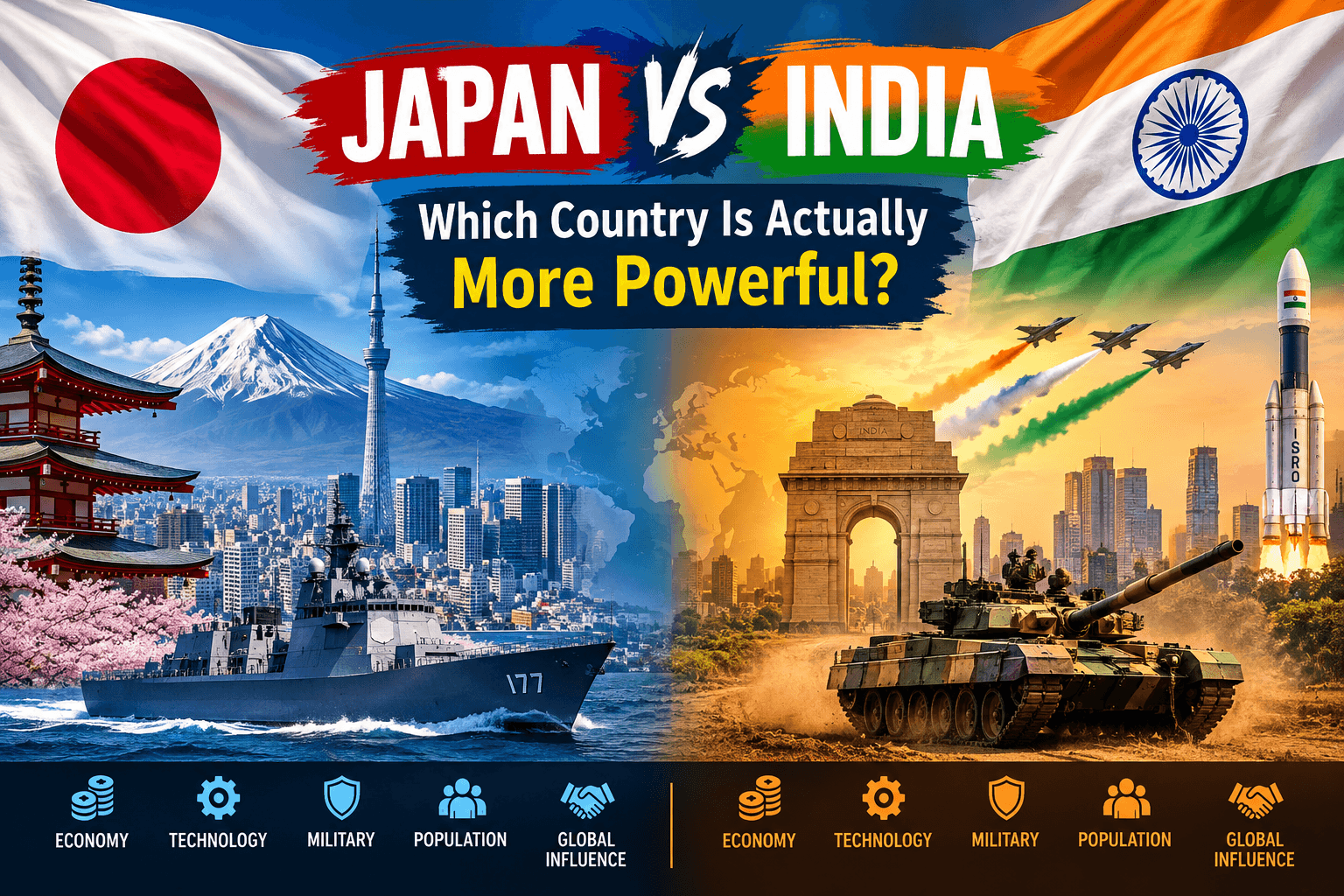

I get why this question keeps popping up. Japan vs India isn’t just some random comparison people throw around — these are two of the biggest names in Asia, and yet they’re almost opposites in how they’ve built their power. One’s got the numbers. The other’s got the polish. So who actually wins?
Honestly, there’s no clean answer. It depends what you mean by “powerful.” Are we talking about the size of the economy? Military muscle? Or just… how good life is if you’re born there? Let’s go through it properly.
Who Has More Influence Right Now?
If you look at how much weight a country throws around in Asia, India’s currently ahead. The Lowy Institute actually ranks India as the third most powerful country in the region — ahead of Japan. That’s not nothing. It’s driven by India’s population, its growing economy, and the fact that it’s part of groups like the Quad, which puts it in the room with the US, Japan, and Australia.
Japan’s still hugely respected, though. It’s usually described as a “middle power,” which sounds like a downgrade but really isn’t. Japan’s influence comes from decades of trust — strong ties with the US, a reputation for stability, and a track record of just… getting things done quietly and efficiently. It doesn’t need to shout to be taken seriously.
So if this were a straight influence contest, India’s pulling ahead on scale, but Japan’s still punching well above its size.
The Economy Question Is Where It Gets Interesting
Here’s the thing about India’s economy — it’s massive now. Bigger than Japan’s in total GDP, which is a genuinely huge shift when you think about how things looked a couple decades ago. Back then, Japan’s economy was seen as untouchable in Asia. That’s just not the story anymore.
But total size isn’t the whole story. Flip to per-person income, and Japan absolutely crushes it — we’re talking roughly 11 to 12 times higher per capita than India. So yeah, India’s economy is bigger as a whole, but if you’re an average person living in Japan, you’re earning way more and probably living a more comfortable life than the average person in India.
It’s kind of like comparing a huge company with tons of employees to a smaller company where everyone’s making six figures. Both are “successful,” just in completely different ways. And honestly, this is the part people miss when they just glance at GDP rankings and call it a day — the total number tells you almost nothing about what life actually looks like for the people living there.
Military: Size vs Sophistication
India’s got more boots on the ground, plain and simple. Bigger active military, bigger defense budget, and it usually ranks higher on those global military strength lists like Global Firepower.
Japan plays a different game entirely. Its Self-Defense Force is small by comparison but seriously advanced — we’re talking top-tier tech, strong backing from the US, and a constitution that actually limits it from going on the offensive in the first place. Japan built its military identity around defense, not conquest, which is a direct result of its post-war history.
So if raw numbers matter to you, India wins that round. If you care more about precision and tech, Japan holds its own without breaking a sweat. Neither approach is “wrong” — they’re just built for different goals.
Technology Still Feels Like Japan’s Turf
This one’s a bit of a gut check for a lot of people. Japan basically defined what “advanced technology” looked like for decades — Toyota, Sony, Panasonic, all that precision engineering and robotics work. That reputation didn’t happen by accident. It came from decades of consistent investment in R&D and a culture that treats engineering as a craft.
But India’s catching up fast, and not in a small way. The IT industry there is enormous, its space program has pulled off genuinely impressive stuff on a tiny budget compared to other countries, and the startup scene is exploding. It’s just a different kind of tech power — more software and services, less hardware and manufacturing. If Japan’s strength is building the machine, India’s strength is writing the code that runs it.
The Population Factor Nobody Can Ignore
India’s population is honestly its biggest asset. More people means a bigger workforce, a bigger consumer market, and frankly, that’s a huge reason India’s total economy managed to overtake Japan’s in the first place. A young, growing population also means India has decades of workforce growth still ahead of it.
Japan’s dealing with the opposite problem — an aging, shrinking population that’s already creating real challenges for its economy and workforce. It’s one of those slow-moving issues that could really shape how this whole comparison looks a decade or two from now. Fewer workers, more retirees, and a shrinking tax base isn’t a crisis today, but it’s a trend Japan can’t ignore.
Quality of Life Still Favors Japan
If you strip away the economics and military stuff and just ask “where would I rather live,” Japan tends to win that conversation. Higher income per person, incredible infrastructure, low crime, systems that just work — trains run on time, healthcare is efficient, and public spaces are clean and well-maintained.
India’s improving on this front too, but there’s still a real gap — income inequality, infrastructure that hasn’t caught up everywhere, and access issues for a big chunk of the population. That said, the trajectory is promising, and this gap probably won’t look the same in another ten years. India’s cities are changing fast, and so is the standard of living in many urban centers.
So… Who Actually Wins?
Honestly? Neither, in a clean-cut way. India wins on scale — economy size, military numbers, population, and rising global weight. Japan wins on quality — wealth per person, tech sophistication, and day-to-day living standards.
Japan vs India isn’t really a battle with one winner. It’s two completely different approaches to power, and both are working for these countries in their own way. Where this goes in the next 10-20 years, though? That’s going to be one of the more interesting stories in global politics to watch play out — especially as India keeps growing and Japan works through its demographic challenges.








2 thoughts on “Japan vs India: Which Country Is Actually More Powerful?”